Made withHyperblog

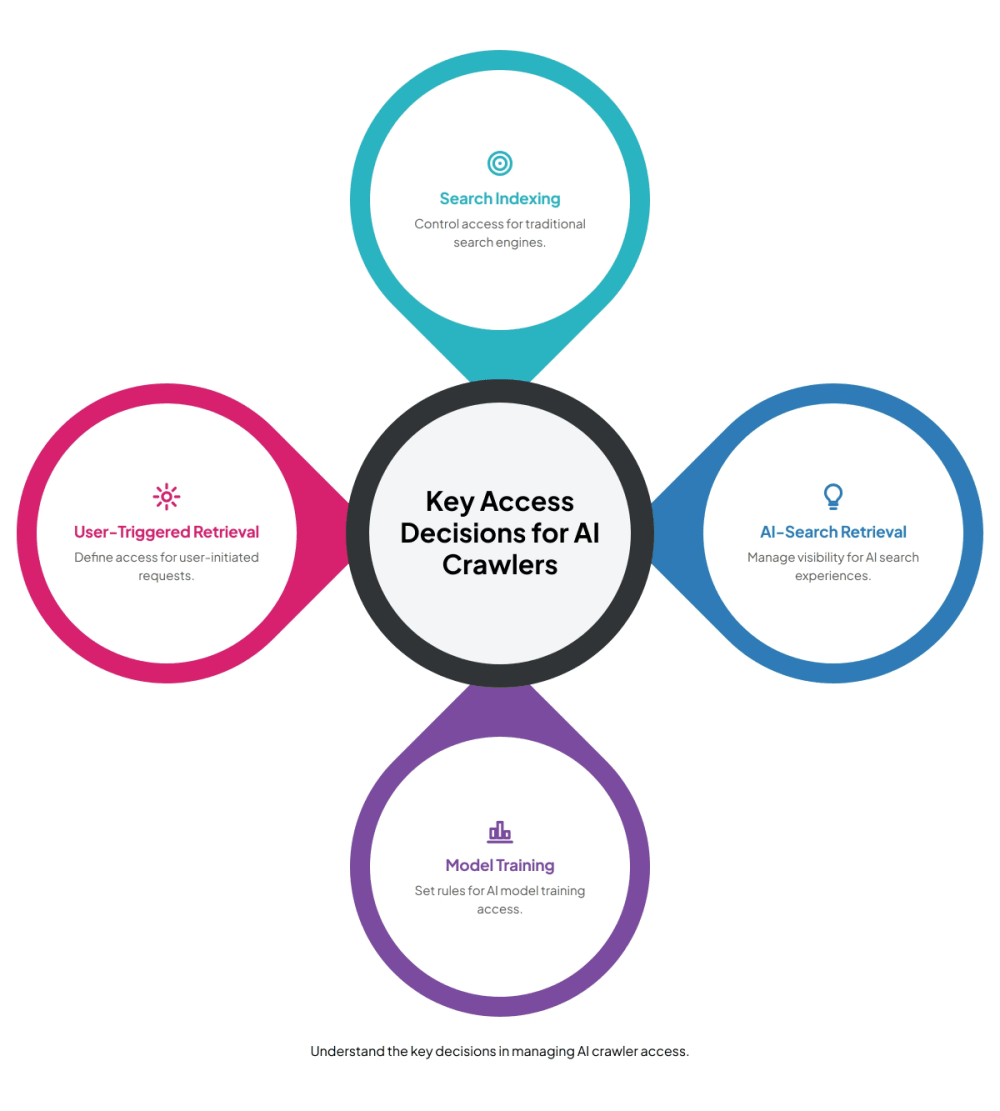
AI crawler controls help publishers decide which automated systems may access their content, for what purpose, and under which conditions. The practical starting point is a written policy that separates search indexing, AI-search retrieval, model training, user-triggered visits, and unauthorized scraping. From there, publishers can express preferences in robots.txt, apply indexing directives where appropriate, and use server or edge controls when a request must actually be blocked.
This distinction matters because a single allow-or-block rule can create unintended consequences. Blocking a training crawler may align with a publisher’s licensing policy, while blocking a search crawler can reduce the chance of appearing in an AI search experience. A robots.txt rule also does not protect private material. Each decision needs a defined purpose, a named owner, and a review process.
Publishers often group every automated request under the label “AI bot.” That shortcut makes policies harder to reason about. A useful policy begins by separating four jobs: conventional search indexing, AI-search discovery, model training, and user-triggered retrieval. The same company may operate different user agents for different jobs, so the organization name alone is not enough to determine a rule.
Search engine crawlers discover pages, render content, and feed search indexes. Blocking them can reduce crawl access and may affect how pages appear in search. Google explains that robots.txt primarily controls crawler access and crawl traffic. It is not the correct method for reliably keeping a page out of search results. Publishers that need a page excluded from Google should use an appropriate noindex method on a crawlable page or restrict access.
Some crawlers collect content for search experiences that answer questions with links and citations. OpenAI documents OAI-SearchBot as the crawler used to surface websites in ChatGPT search features. A publisher may choose to allow this crawler while making a different choice for model-training access. This is a visibility decision, not a guarantee that a page will be cited or receive traffic.
Training crawlers support the development or improvement of models. OpenAI identifies GPTBot as its model-training crawler and treats its robots.txt setting independently from OAI-SearchBot. Google also documents Google-Extended as a control related to certain generative AI uses without changing a site’s inclusion in Google Search. These examples show why publishers need purpose-specific rules rather than one blanket policy.
A user may ask an assistant to open a specific page. OpenAI describes ChatGPT-User as a user-triggered agent rather than an automatic web crawler and notes that robots.txt rules may not apply in the same way. Publishers that must prevent access to private or licensed content need authentication, authorization, and network-level enforcement. A preference file cannot replace those controls.
The Robots Exclusion Protocol is a public set of crawl instructions stored at the root of a host. RFC 9309 defines how user-agent groups, allow rules, and disallow rules are parsed. It also states that the protocol is not access authorization. The file communicates preferences to compliant crawlers, but it does not create a security boundary.
A robots.txt file can target a named user agent, a path, or a broad group of crawlers. It can also allow a more specific path inside a disallowed area. Rules apply to the host where the file is served, so a company using a primary domain, documentation subdomain, and separate asset host may need different files and policies.
Robots.txt cannot reliably keep confidential information private, remove an already indexed URL, or force every automated client to comply. It also exposes the paths listed in the file. Sensitive content should sit behind authentication or another access-control layer. When the business requirement is “this request must be denied,” use an enforceable server, CDN, WAF, or application control.
A policy matrix prevents technical changes from getting ahead of business decisions. Create one row for each important user agent and record its stated purpose, the content it may access, the preferred action, the enforcement method, the evidence source, and the next review date. The source should be the crawler operator’s current documentation because names, purposes, and behavior can change.
For a B2B publisher, the matrix might allow search crawlers across public articles, allow AI-search crawlers across the same library, disallow training crawlers from a paid research area, and block unknown high-volume scrapers at the edge. Another publisher may choose broader access because discovery is the primary goal. The right policy follows the content model, contracts, licensing position, and distribution strategy.
Avoid copying a long community blocklist without verification. An outdated list can target retired user agents, miss new ones, or block systems that support desired discovery. Treat third-party lists as leads for investigation. Confirm each token with a current first-party source and test the resulting behavior.

Download our in-depth guide on managing AI crawler access effectively.
Keep the file readable. Use a separate user-agent group when the action differs by crawler, comment the business purpose, and avoid contradictory rules. A publisher that wants search discovery but does not want OpenAI model-training access could allow OAI-SearchBot and disallow GPTBot. The exact rules should be reviewed against OpenAI’s current crawler documentation before deployment.
A simple policy might contain a group for OAI-SearchBot with an empty Disallow value, followed by a GPTBot group with “Disallow: /”. A more selective policy could block a private research path while allowing public articles. Test path matching carefully because the most specific matching rule can determine access, and matching behavior is defined by the protocol and crawler implementation.
Do not block CSS, JavaScript, images, or other resources without checking how the change affects rendering and understanding. Google warns that blocking important resources can make a page harder to interpret. A rule that looks efficient in a text file can reduce the quality of the rendered page available to a crawler.
Robots.txt works when a crawler chooses to honor it. Some automated clients ignore it, misidentify themselves, rotate user agents, or operate from changing infrastructure. If the risk involves licensed content, infrastructure cost, abuse, or sensitive data, add an enforcement layer. Options include authentication, signed URLs, rate limits, bot management, WAF rules, and application-level authorization.
Cloudflare’s AI Crawl Control documentation illustrates the difference between expressing directives and enforcing access. Its tooling can monitor crawler activity, compare behavior with robots.txt, and apply blocking actions. Publishers using another CDN or hosting stack can follow the same principle: state the policy publicly, observe actual requests, and enforce only where the business requirement justifies it.
Share your thoughts on managing AI crawler access.
What worries you most about AI crawlers?
Enforcement also needs an exception path. Search tools, accessibility services, uptime monitors, partners, and internal systems can resemble automated traffic. Start with logging or a controlled rule where possible, review false positives, and document who can approve a block or allowlist change.
A published policy is the beginning of the workflow. Review server or CDN logs for user-agent, path, response code, request rate, IP information, and timestamps. Compare those requests with the operator’s published IP data when available. User-agent strings alone are easy to imitate, so identity checks should use the verification method provided by the operator.
Create a small monitoring view that answers five questions: Which named crawlers are active? Which sections do they request? Are they following disallow rules? Are requests creating infrastructure pressure? Did visibility or referral patterns change after a policy update? This evidence makes the next policy review more useful than a static list of allowed and blocked names.
Changes should be versioned and dated. Record the previous rule, the new rule, the reason, the approver, and the expected observation period. OpenAI notes that its systems may take about 24 hours to adjust after a robots.txt update. Other services have their own refresh behavior, so avoid judging a change from a few immediate requests.
Begin with an inventory of public articles, gated assets, customer-only pages, documentation, media, and application routes. Assign each group a distribution goal and sensitivity level. Public educational content may support broad discovery, while licensed reports or account pages require stricter access.
Next, list the crawlers that actually appear in logs and the major systems relevant to the company’s distribution strategy. Verify each user agent through current operator documentation. Classify its purpose, then decide allow, disallow, monitor, or enforce. Keep “monitor” as a valid choice when evidence is limited.
Draft the smallest robots.txt change that expresses the decision. Test syntax, confirm the file is available at the root of the correct host, and check that the change does not block important search resources. Deploy through the normal review process, then inspect logs and search diagnostics during the observation window.
An AI crawler is an automated client that visits web pages for a stated purpose such as AI search discovery, retrieval, or model training. Publishers should verify each crawler’s purpose in the operator’s current documentation before setting a rule.
No. OpenAI documents GPTBot for model training and OAI-SearchBot for ChatGPT Search. Their controls are independent, although allowing a search crawler does not guarantee visibility or citations.
Not reliably. Robots.txt primarily controls crawl access. For Google, use a noindex directive on a crawlable page or an access-control method when the page must stay out of search.
There is no universal answer. Decide by crawler purpose, content sensitivity, licensing policy, infrastructure cost, and distribution goals, then document one owner and review date for each decision.
Use enforceable controls when access must actually be prevented, such as for sensitive or licensed content, abusive request volume, infrastructure protection, or clients that do not follow robots.txt.
Review it at least quarterly and whenever crawler documentation, licensing terms, content hosts, distribution goals, or traffic patterns change.
Finally, review the matrix quarterly and whenever a crawler operator changes its documentation, a licensing policy changes, a new host launches, or an unusual traffic pattern appears. The content, legal, SEO, and infrastructure owners should all understand the tradeoff. Crawler access is a publishing policy with technical implementation, not a one-time SEO setting.
Crawler policy works best when the publishing workflow already produces clean canonical URLs, crawlable internal links, current sitemaps, accurate metadata, and structured content. Those foundations help allowed crawlers find and interpret public pages. They do not override an access decision, but they reduce ambiguity once access is permitted.
Hyperblog keeps post content, metadata, schema controls, canonical settings, and AI-readable formats in the same publishing workflow. Teams can use its technical SEO review to check post-level details while managing robots.txt and enforcement decisions at the appropriate domain or infrastructure layer. The policy still needs human ownership, source verification, and periodic review.
The goal of AI crawler controls is to make access intentional. Separate discovery from training, separate preferences from enforcement, and separate public content from material that requires real authorization. A short verified policy with monitoring is more dependable than a large blocklist copied once and forgotten.
Start with the crawler purpose, confirm the operator’s current documentation, apply the smallest suitable control, and measure what happens. That process protects keyword and distribution goals while giving legal, content, SEO, and infrastructure teams a shared record of the decision.
Subscribe to Our Newsletter
Stay up to date with our latest news and updates.