
Blogs
How to Build Topic Clusters for SEO & AI Search Success
 Muthu
Muthu27 May 2026

SHARE:
MuthuEvery content team eventually hits the same wall. They publish consistently, the posts are well-written, the keywords are researched, and yet the organic traffic plateaus. Rankings are scattered. Some posts do reasonably well. Most disappear into page three and never resurface.
The problem is almost never the quality of individual posts. It is the absence of architecture.
Topic clusters are the structural solution to scattered content. When built correctly, they create the conditions for compounding authority, where every new piece of content you publish makes your existing content stronger, and your existing content makes the new piece more likely to rank. This guide covers how topic clusters work, how to build them, and how to structure them for both traditional search engines and AI-powered answer systems.
A topic cluster is a content architecture model built around three components.
A pillar page is a comprehensive, authoritative piece of content that covers a broad topic at a high level. It is designed to rank for a high-volume, broad keyword and to serve as the hub of a content network. A pillar page on a topic like 'content marketing' might be 3,000 to 5,000 words long and touch on strategy, SEO, distribution, measurement, and lead generation without going deep on any single subtopic.
Cluster pages (also called cluster content or supporting content) are individual blog posts that each cover one subtopic from the pillar in depth. These posts target more specific, lower-competition keywords. Using the content marketing example, cluster pages might cover 'how to create a content calendar,' 'content distribution strategies,' 'how to measure content ROI,' and 'content marketing for B2B SaaS.'
Internal links are the connective tissue that makes the cluster function. Every cluster page links back to the pillar page. The pillar page links out to each cluster page. Cluster pages may also link to each other where relevant. This network of internal links is what tells search engines and AI crawlers that these pieces of content are part of a coherent, authoritative body of work on a topic.
The model was popularised by HubSpot researchers around 2017, but its foundations are grounded in how search engines evaluate topical authority, a concept that predates the cluster terminology by several years.
Google's ranking systems have shifted significantly from keyword-matching toward semantic understanding. RankBrain, BERT, and MUM have progressively improved Google's ability to understand what a piece of content is actually about, who it is for, and how comprehensively it covers a subject.
Topical authority is the degree to which Google views a domain as a credible, comprehensive source on a particular subject. A site that has 30 pieces of content covering every meaningful angle of a topic signals strong topical authority. A site that has one well-optimised post on the same topic signals much less, regardless of how good that single post is.
Topic clusters are the operational structure for building topical authority systematically. Each cluster page you publish on a subtopic adds a signal that your domain is a serious, comprehensive source on the parent topic. Over time, that accumulating authority begins to lift rankings across the entire cluster, including the pillar page and the individual posts.
What is the biggest challenge you face in building topic clusters?
Internal links pass page authority. When your pillar page earns backlinks and builds strong domain authority from external sources, the internal links from that pillar to cluster pages distribute some of that authority to the supporting content. Cluster pages that would struggle to rank independently become significantly stronger when they are anchored to a high-authority pillar.
This distribution also works in reverse. Cluster pages that rank for long-tail keywords and accumulate their own engagement signals and occasional backlinks pass authority back to the pillar through the return link. The cluster becomes a self-reinforcing system where strength compounds over time.
Google's own documentation on how it evaluates site structure confirms that discoverability and meaning improve when pages are connected clearly and logically. A cluster architecture makes the relationships between pages explicit, both to crawlers and to readers.
A well-linked topic cluster creates a clear crawl path for Googlebot. When the pillar page is crawled, the internal links to cluster pages guide the crawler to each supporting piece. When cluster pages are crawled, the return link to the pillar confirms the relationship. Pages that exist in isolation without strong internal linking are crawled less frequently and may be indexed more slowly.
For sites building content at scale, cluster architecture is also a practical crawl budget optimisation strategy. The more clearly a site signals the relationships between its pages, the more efficiently crawlers can prioritise and index new content.
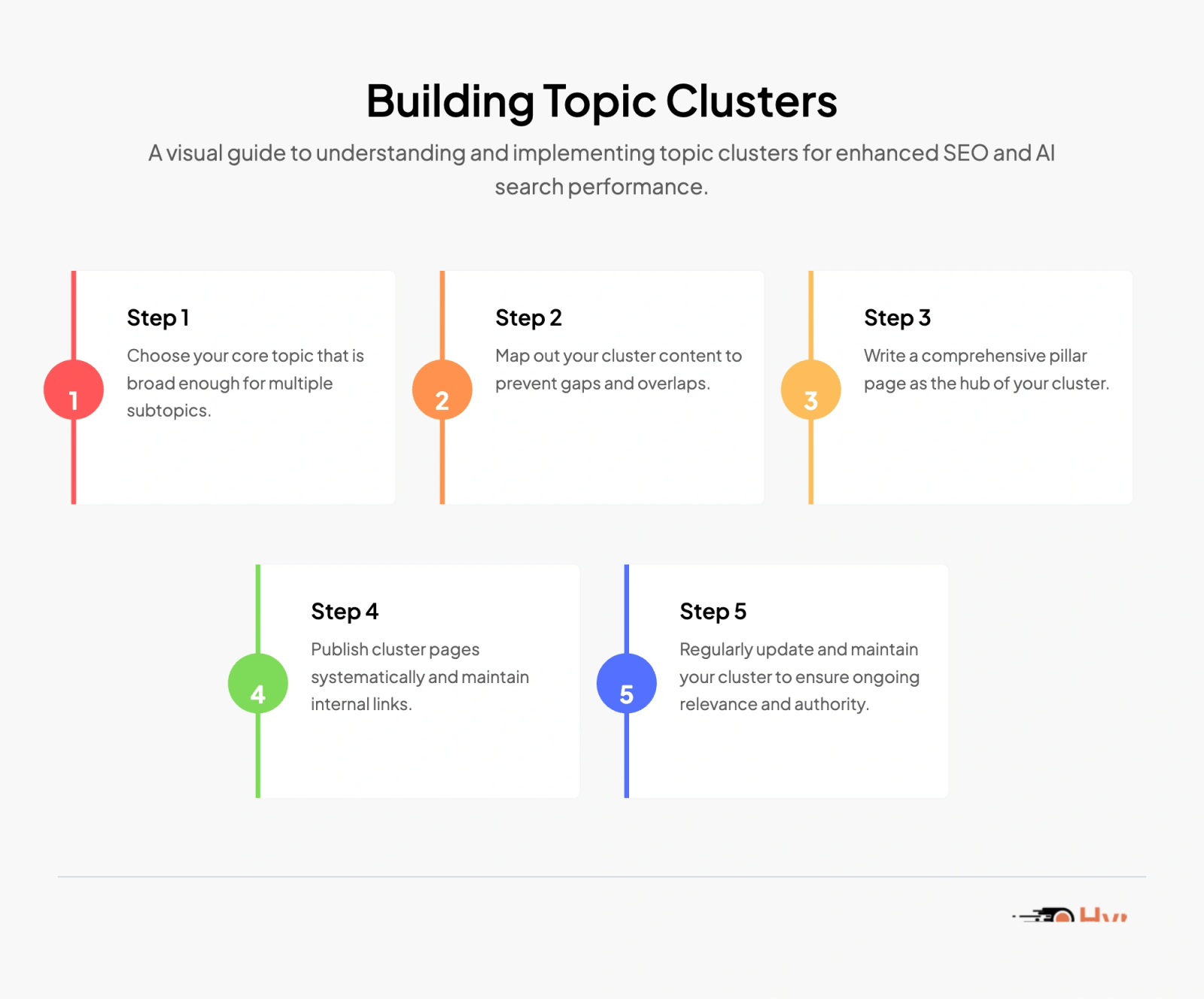
The pillar topic should be broad enough to support 8 to 15 cluster pages, but specific enough that you can realistically build authority in it. 'Marketing' is too broad. 'Email marketing for SaaS' is appropriately specific for a business in that space.
A useful test: can you list 10 distinct subtopics within this topic that each warrant their own 1,500-word post? If yes, you have a viable pillar topic. If you struggle to get past 4 or 5, the topic is too narrow.
Your pillar topic should also align with what your business sells or the problem it solves. Topical authority that has no connection to your product creates traffic without commercial intent. The goal is traffic that converts, not traffic for its own sake.

Download our comprehensive guide to mastering topic clusters for SEO and AI search.
Once the pillar topic is chosen, map the cluster pages before writing any of them. This prevents gaps and overlap, and it lets you plan internal links logically before the content exists.
What to document per cluster page
A completed cluster map gives you a publishing roadmap. Start with the pillar page, then publish cluster pages in an order that lets you begin internal linking immediately. Do not wait until the entire cluster is complete to start linking. Every page you publish should link to the pillar, and the pillar should link back to every cluster page as they are published.
The pillar page is not a collection of summaries. It is a comprehensive standalone resource that also serves as an index to deeper content. It should answer the core question of the topic fully enough that a reader comes away with a complete understanding, while naturally inviting them to explore specific aspects in more depth via the cluster pages.
What a strong pillar page includes
A blog CMS like Hyperblog automatically generates a table of contents on every post, which is particularly valuable for pillar pages where navigation is critical for both user experience and search engine understanding of the page structure.
Each cluster page should go deep on its specific subtopic in a way the pillar page does not. Where the pillar page introduces internal linking as a concept in two paragraphs, the cluster page on internal linking covers anchor text strategy, crawl depth, link equity distribution, tools for auditing internal links, and common mistakes.
What every cluster page must include
Hyperblog's built-in internal linking feature surfaces relevant internal link suggestions as you write, making it significantly easier to maintain the cluster architecture without manually cross-referencing your content library every time you publish a new post. This is the kind of operational friction that causes cluster architecture to break down over time without tooling support.
A topic cluster is not a one-time project. It requires ongoing maintenance. New cluster pages should be added as subtopics emerge. Existing pages should be refreshed when the content becomes outdated. The pillar page should be updated to link to new cluster pages as they are published.
Search Console data is the right diagnostic tool for cluster health. If cluster pages are ranking but the pillar page is not improving, the internal linking from cluster pages back to the pillar may be insufficient. If the pillar is ranking but cluster pages are not receiving traffic, the subtopic targeting may need refinement.
Building topic clusters for traditional search is well-established. Building them for AI search is newer territory, but the underlying logic is similar and the structural requirements are in some ways even more demanding.
When ChatGPT, Perplexity, or Google's AI Overviews retrieve content to answer a query, they are not just looking at a single page. The retrieval systems evaluate the source domain as part of assessing the credibility and comprehensiveness of a result. A domain with a coherent, well-linked body of content on a topic is more likely to be cited than a domain with a single strong post surrounded by unrelated content.
This is topical authority applied to AI retrieval, and it favours exactly the kind of cluster architecture that traditional SEO recommends. The difference is that AI systems are also sensitive to content structure at the page level, not just the domain level.
For AI search specifically, each cluster page should include several structural elements that improve retrieval likelihood.
TL;DR at the top
AI retrieval systems often pull from the opening section of a page first. A clear, accurate summary of what the post covers and what conclusion it reaches improves the likelihood of the content being cited. Hyperblog automatically generates a TL;DR for every post optimised for LLM retrieval, removing the need to write this manually while ensuring it is formatted correctly for AI crawlers.
Question-format headings
Perplexity and AI Overviews both favour content where the heading directly matches the query. 'How does internal linking affect topical authority?' as a heading is more retrievable than 'Internal Linking and Authority.'
Direct answers before elaboration
State the answer to the section's question in the first sentence, then elaborate. AI systems retrieve the first substantive sentence of a section frequently because it is most likely to directly answer the query.
FAQ sections
Including an FAQ at the end of each cluster page with schema markup serves two purposes: it gives Google structured data for rich results, and it gives AI systems a clean, parseable set of direct answers that are easy to cite. Hyperblog generates FAQ sections automatically on every post, applying the correct FAQ schema without manual implementation.
AI systems are designed to understand entities: people, organisations, concepts, and the relationships between them. A topic cluster signals a coherent entity, a domain that is an authoritative source on a defined subject area.
Reinforce entity clarity across your cluster by using consistent terminology for core concepts, ensuring every post includes an author bio linked to an author page, referencing and linking to authoritative external sources, and maintaining consistent schema markup across all cluster pages that identifies the author, publisher, and topic.
Some teams publish cluster pages before the pillar page exists. The result is strong individual posts with no hub to link back to, no authority concentration, and no coherent architecture for crawlers to follow. Always build the pillar first.
Each page in a cluster should target a distinct keyword. When two cluster pages target the same or very similar keywords, they cannibalise each other's rankings, splitting authority and confusing search engines about which page should rank.
Many content teams link from the pillar to cluster pages but forget to link back from cluster pages to the pillar. The return link is essential for distributing authority bidirectionally and for confirming the relationship between the pages to crawlers.
A cluster that is built and never updated becomes a liability over time. Outdated statistics, superseded recommendations, and broken internal links all erode the topical authority the cluster was designed to build. Treat the cluster as a living system, not a completed project.
A pillar page that is 800 words long cannot anchor a cluster of 15 posts. The pillar needs to be genuinely comprehensive to earn the rankings and authority that make the cluster architecture valuable.
The most important thing to understand about topic clusters is that their value compounds in a way that individual posts do not.
A single post earns traffic from the keywords it ranks for. A well-built topic cluster earns traffic from the keywords each cluster page ranks for, plus additional authority on the pillar keyword that no individual post could achieve alone, plus an increasing likelihood of AI citation as the cluster establishes domain-level topical authority.
Each new cluster page you publish makes every existing page in the cluster slightly stronger. Each refresh of an existing page reinforces the freshness signals across the cluster. Each new backlink earned by any page in the cluster distributes partial authority to every other connected page.
A topic cluster is a content architecture model that includes a pillar page and several cluster pages, all linked together to enhance SEO and AI search rankings.
They build topical authority and distribute link equity, improving search rankings for all pages within the cluster.
It serves as the hub of the topic cluster, providing comprehensive coverage of the core topic and linking to all cluster pages.
Common mistakes include building clusters without a pillar, targeting the same keyword across pages, and neglecting to update content.
They enhance domain-level topical authority, making content more likely to be cited by AI systems.
This is content compounding. It is the difference between a publishing operation that produces articles and one that builds an asset. The architecture is what separates the two.
If you are not building topic clusters, you are almost certainly leaving significant organic and AI search traffic on the table. The good news is that the architecture is learnable, the tooling to support it is increasingly capable, and the competitive advantage available to teams who build it systematically is still substantial in most industries.
Start with one cluster. Build it well. Measure what happens. Then build the next one with that knowledge.
Last updated May 2025. Google's guidance on site structure and internal linking is available at developers.google.com/search. Perplexity's content retrieval preferences are documented in their publisher resources.
Subscribe to Our Newsletter
Stay up to date with our latest news and updates.
Join our readers
No spam. Unsubscribe anytime.