Made withHyperBlog
Content decay is a sustained loss of organic search visibility or value from a page that once performed better. The practical way to detect it is to compare completed time windows, inspect impressions, clicks, click-through rate, position, and query coverage together, then rule out seasonality, demand changes, tracking problems, and technical issues before editing the article.
That distinction matters. A page can lose clicks because fewer people are searching, because the search results changed, or because another page on your site started competing for the same intent. Treating every decline as stale content leads to unnecessary rewrites and weakens clear keyword ownership.
A useful decay diagnosis has three parts: the page had a meaningful baseline, the decline persists across a fair comparison window, and the loss is tied to the page or its query set rather than a sitewide or marketwide event. One bad week is a signal to investigate, not proof of decay.
Seasonal pages often rise and fall on a predictable schedule. A product category can also lose demand even when its rankings stay stable. Search-result features may absorb clicks while impressions and average position remain similar. Technical changes can make a page harder to crawl or index. Analytics configuration changes can make engagement or conversion data look worse without changing search performance.
Google recommends using Search Console to inspect the shape of a traffic drop, compare periods, and look at pages and queries. It also recommends Google Trends when you need to separate a site-specific issue from a wider change in search interest.
Start with completed data. Search Console data can lag, so exclude today and other incomplete dates. For a routine monthly review, compare the latest completed 28 days with the preceding completed 28 days. Then add a longer baseline, such as the trailing six months, and a year-over-year comparison for strongly seasonal topics.
Normalize page URLs before grouping results. Treat HTTP and HTTPS, www and non-www, letter case, query parameters, and trailing-slash variants consistently. Otherwise one page can look like several small pages and hide its real trend.
Analyze page and query together. Page-level totals tell you where visibility moved. Query-level data explains why. A page may lose one high-volume query while gaining several relevant long-tail queries, or it may hold clicks while its original intent shifts. Search Console supports comparisons and filters across dates, queries, pages, countries, devices, and search appearance.
Keep search and on-site behavior separate during diagnosis. Search Console is the source of truth for Google Search performance. Your analytics platform explains what visitors do after they arrive. Use both, but do not treat sessions and Search Console clicks as interchangeable because their collection methods and attribution differ.
Falling impressions can mean the page appears for fewer searches, ranks for fewer queries, or serves a topic with shrinking demand. Compare the page's query set, not just its total impressions. If impressions fall across most important queries while search interest remains steady, the page may be losing topical relevance or competitive coverage.
When visibility is stable but clicks fall, inspect click-through rate, title relevance, description alignment, and changes to the result page. A new rich result, answer feature, or stronger competing title can reduce clicks without a large ranking change. This is often a snippet and intent problem before it is a full content-decay problem.
Share your experience with content decay to help us understand its impact.
What is your experience with content decay?
Position is a directional metric because it is averaged across searches, locations, devices, and result types. Look for a sustained drop across the primary keyword and close-intent queries. A small movement may not justify a rewrite. Google advises against drastic changes when a page has only a minor position decline.
A healthy article often earns impressions from a family of related questions. If that relevant query set narrows over several periods, the page may no longer answer the topic as completely as competing results. Exclude irrelevant queries and branded navigational searches so the count reflects the page's real job.
URL switching can expose unclear keyword ownership. Normalize the URLs, group close-intent queries, and check whether two pages serve the same page type and reader job. Shared branded wording alone is not cannibalization. A product page and an educational guide can both appear for a branded topic without competing for the same intent.
If clicks remain stable while engagement or key events fall, the page may be attracting a less relevant audience, setting the wrong expectation in search, or offering an outdated next step. Review landing-page behavior, conversions, and contextual calls to action. Diagnose the mismatch before expanding the article.

Download our comprehensive guide on detecting and managing content decay.
Check indexing, canonical tags, redirects, robots rules, internal links, rendering, page speed, and structured data when the timing matches a site change. If many unrelated pages fall together, start with a sitewide technical investigation. Rewriting one article cannot solve a template or indexing problem.
A scorecard helps a team prioritize reviews, but its thresholds should reflect the site's normal volatility. Compare each page with its own history and with similar page types. A high-traffic evergreen guide may justify investigation after a modest sustained loss, while a new or low-volume article needs more data.
Give one point for each confirmed condition: clicks declined in both the short comparison and the longer baseline; impressions declined for important queries; average position worsened materially; relevant query coverage shrank; click-through rate fell while impressions were stable; useful on-site outcomes declined; or URL switching appeared for the primary intent.
Use the total as a triage aid. Zero or one point usually means keep monitoring. Two or three points calls for manual investigation. Four or more points makes the page a strong review candidate. Never automate a rewrite from the score alone. The score identifies where human diagnosis is worth the time.
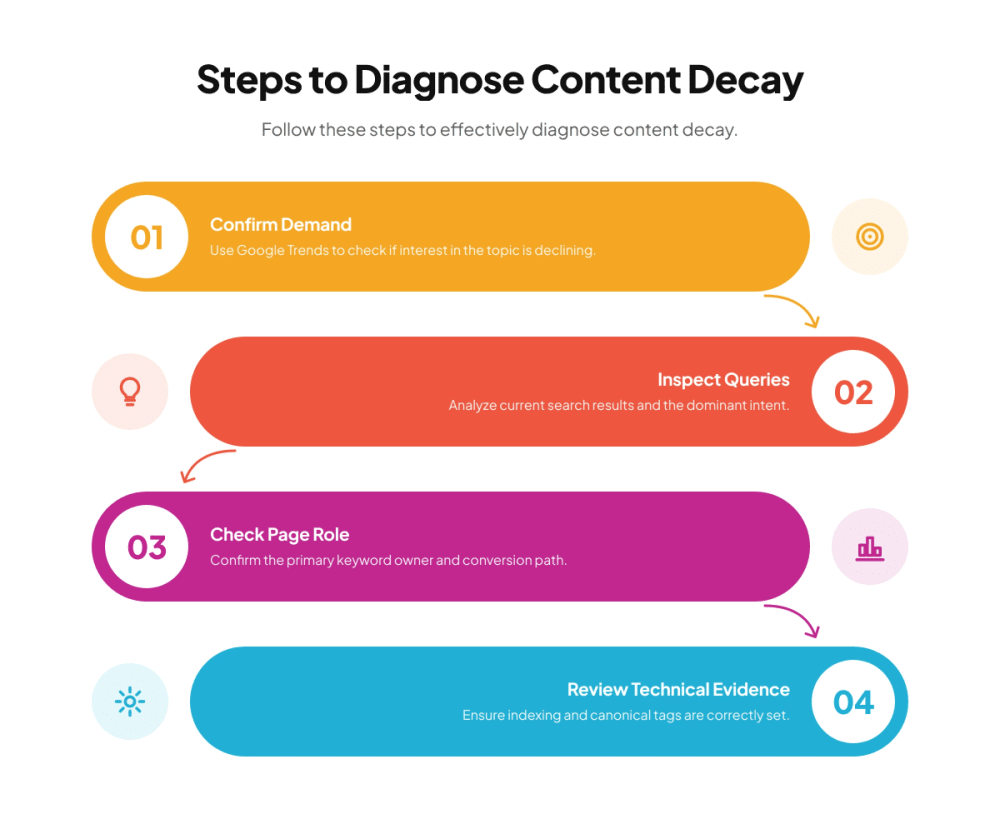
First, confirm demand. Compare the topic in Google Trends using a relevant location and time range. Trends is normalized interest data rather than absolute search volume, so use it to understand direction and seasonality. If the whole topic is declining, rewriting the page may not restore traffic.
Second, inspect the queries and current search results. Determine whether the dominant intent, content format, or expected depth changed. Record whether the page still matches the reader's job. Avoid copying competitor structures mechanically. Look for missing evidence, unclear explanations, outdated examples, or a weak answer to the primary task.
Third, check the page's role in the site. Confirm its primary keyword owner, internal links, parent pillar, and conversion path. If another page serves the same intent better, consolidation may be safer than maintaining two weak owners. If the intent is distinct, strengthen the boundary with clearer titles, headings, and internal anchor text.
Fourth, check technical evidence. Confirm that the preferred URL is indexable and canonical, redirects resolve correctly, internal links point to the normalized URL, and recent releases did not alter rendering. Annotate major site changes and search updates in the monitoring sheet so future reviewers can match timing to causes.
Content decay is a sustained loss of organic search visibility or value from a page that previously performed better. Confirm it with comparable time windows and query-level evidence before changing the page.
Compare completed periods for clicks, impressions, click-through rate, position, and relevant query coverage. Then rule out seasonality, demand shifts, technical problems, tracking changes, and search-result changes.
There is no universal percentage. Use the page's normal volatility, data volume, seasonality, and longer baseline to decide whether a sustained decline is meaningful.
A monthly review works for most teams. Compare the latest completed 28 days with the previous 28 days and a longer baseline, while reviewing critical pages more frequently if needed.
No. Keep, monitor, investigate, reposition, consolidate, or refresh based on the cause. A rewrite will not fix lower search demand, a technical issue, or unclear keyword ownership by itself.
Changing the date alone is unlikely to help. Make substantial, reader-useful updates, document what changed, and keep the date accurate to the actual work.
Keep the page when its important queries and useful outcomes are stable. Monitor it when the decline is recent, low-volume, or plausibly seasonal. Investigate when several signals move together but the cause is uncertain.
Refresh the page when its intent is still valuable and the evidence shows outdated facts, weak examples, missing subtopics, or a snippet that no longer matches the answer. Reposition it when the page attracts a different but valuable intent that deserves explicit ownership. Consolidate only when two pages genuinely serve the same intent and page type. Plan redirects carefully so authority and internal links point to the surviving owner.
A refreshed date is not a strategy. Google advises making substantial, useful changes for readers rather than changing dates to make content appear fresh. Document what changed, why it changed, and which metric should respond.
Export or record the latest completed 28 days, the previous completed 28 days, and a trailing baseline. Group normalized URLs, then calculate changes in clicks, impressions, click-through rate, and weighted average position. Flag only pages with enough data to support a useful comparison.
Review each flagged page at the query level. Check seasonality, search-result changes, sitewide patterns, technical events, and URL switching. Assign one explicit action: Keep, Monitor, Investigate, Refresh, Reposition, or Consolidate. Give every primary query cluster one owner and record the decision in the content roadmap.
After an update, annotate the publication date and scope of the change. Wait for a reasonable amount of complete data before judging the result. Compare the same query set and reader outcome, and avoid taking credit for a seasonal rebound that affected the whole market.
Hyperblog gives content teams a managed publishing workflow for creating and maintaining SEO-focused blog content. Teams can use Search Console and their analytics tools to identify decay, then update the right article, improve its structure, strengthen internal links, and align the next step with reader intent. Hyperblog's own analytics product is currently listed as coming soon, so search and behavior diagnosis should continue in the connected measurement tools your team trusts.
Content-decay monitoring works best as an ownership system, not a rewrite queue. Measure consistent windows, combine metrics with intent, and preserve a clear job for every URL. That approach catches genuine erosion early while protecting pages that are seasonal, temporarily volatile, or already doing the job they were designed to do.
Subscribe to Our Newsletter
Stay up to date with our latest news and updates.