
SEO for Startups
How these 16 startups used SEO to win customers, and real revenue
 Muthu
Muthu14 June 2026

SHARE:
Product-led content SEO |
Built a content engine around SEO problems, keyword research, technical SEO, and content marketing |
Teach the market before selling to it |
Plausible Analytics | Opinion-led and product-led content | Used transparent blogging, privacy positioning, and Google Analytics alternative content to grow without paid ads | Strong positioning can turn content into customer acquisition |
Zapier | Programmatic SEO | Built app and integration pages at scale | Product inventory can become search inventory |
Wise | Programmatic SEO | Built currency conversion pages for thousands of currency-pair searches | Useful tools can rank and convert at the same time |
Webflow | Template SEO | Built searchable template pages that lead directly into product usage | Templates can reduce the distance from search to signup |
Nomad List | Data-led programmatic SEO | Built location pages for digital nomad queries | Unique data makes scaled pages useful |
G2 | Category and comparison SEO | Built software-category and comparison pages at scale | Buyer-intent pages can capture decision-stage traffic |
Notion | Template marketplace SEO | Built a large template marketplace with categories and community creators | User-generated templates can become a searchable growth loop |
ClickUp | Template SEO | Built 1,000+ templates across work categories | Templates can capture workflow-specific searches |
Miro | Template SEO | Built thousands of visual collaboration templates | Searchers often want a starting point, not just information |
Typeform | Template SEO | Built form and survey templates for many use cases | Bottom-funnel templates turn intent into product usage |
Canva | Template SEO | Built searchable design templates around high-volume visual creation jobs | Search demand can map directly to creation intent |
VEED | Tool-led SEO | Built pages around individual video editing jobs and tools | Free tools can become acquisition pages |
Jasper | Content hub SEO | Built a blog around AI marketing and content workflows | AI startups can educate markets that are still forming |
Copy.ai | Content hub SEO | Built practical AI workflow content for marketers and sales teams | Category education can create demand |
Glasp | AEO / AI-search optimization | A study on Glasp found AI-answer optimization produced a treatment-aligned lift in ChatGPT referral traffic | AI discovery is becoming part of SEO strategy |
Template SEO |
Tool that performs specific jobs | Free tool SEO |
Complex B2B product | Educational and comparison SEO |
New AI category | Category education and workflow SEO |
Data-heavy product | Data-led programmatic SEO |
Strong founder POV | Opinion-led content SEO |
MuthuMost startups wait too long to take SEO seriously.
They spend money on ads. They post on LinkedIn. They launch on Product Hunt. They try cold outreach. They chase partnerships.
All of those can work.
But the startups that build SEO early get something different: a compounding acquisition channel.
That is why these startup SEO case studies matter. They show that SEO is not just a traffic channel. It can become a customer acquisition system, a product education layer, a trust engine, and in some cases, a growth moat.
The best startup SEO stories usually do not come from publishing random blog posts. They come from one of four plays:
This is where many startups get SEO wrong.
They think the job is to “publish more content.”
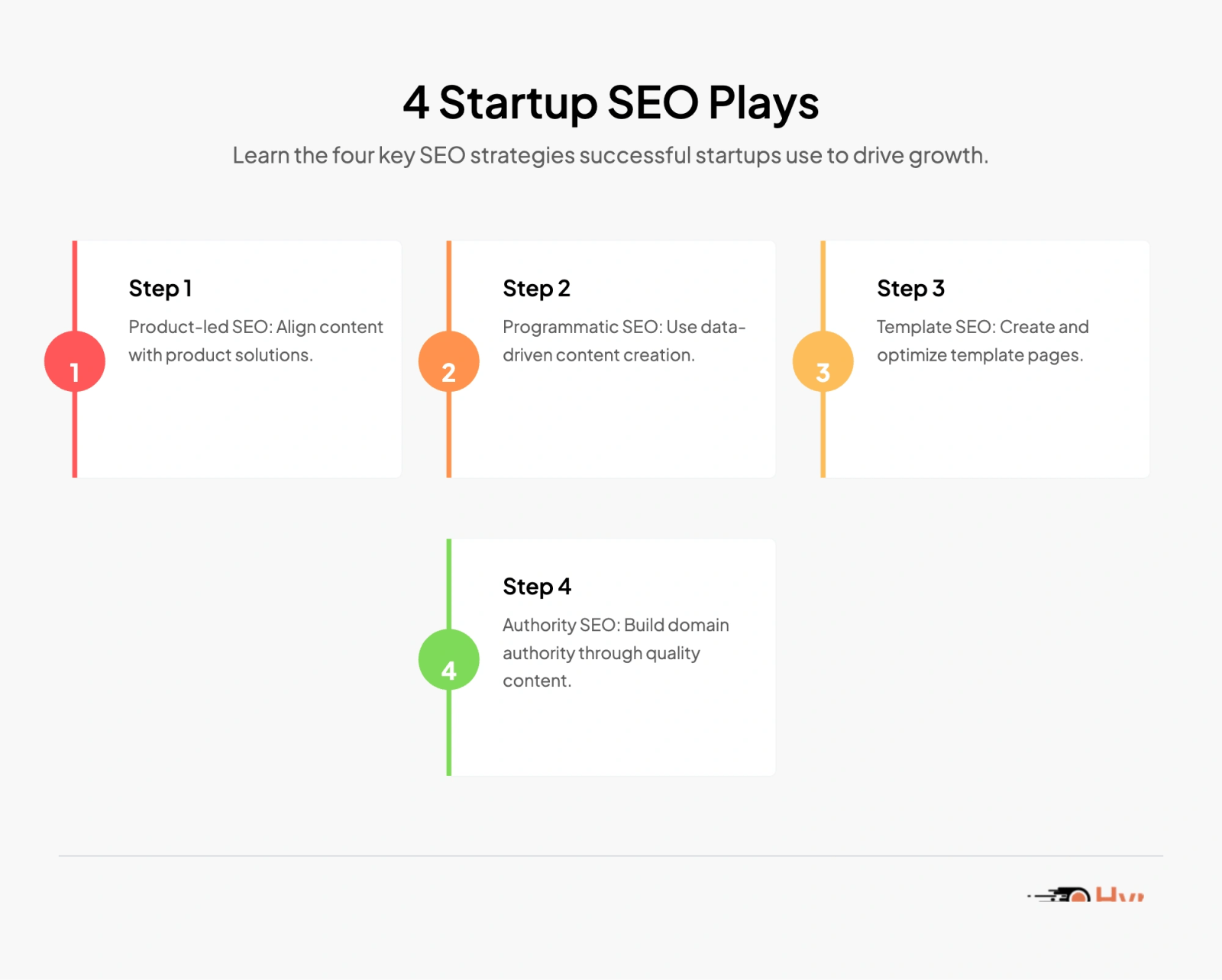
The real job is to build a system where every article, template, comparison page, and glossary entry connects search demand to product value.
That is also the philosophy behind Hyperblog. A blog should not just help you publish. It should help every post become technically ready for search, structured for AI discovery, connected through internal links, and equipped to convert readers into leads.
Before we get into the startup SEO case studies, we need to answer the obvious question.
Does SEO still matter for startups in the AI era?
Yes, but the rules have changed.
Ahrefs’ guide on SEO for startups notes that startup SEO is about attracting valuable search traffic by making a startup’s site more visible for relevant keywords. It also cites the classic B2B search behavior problem: many B2B researchers start with generic, non-branded searches, meaning they look for the product or solution category before they know which vendor they want.
That matters because startups usually do not have brand demand early.
Nobody is searching your brand name yet.
But they are searching for:
SEO gives startups a way to show up before the buyer knows who they are.
How crucial is SEO for startup growth?
Ahrefs is also a strong example of this itself. In its startup SEO guide, Ahrefs says it gets about 1.1 million monthly visits from search engines, with an estimated PPC replacement value of $2 million per month, and describes itself as a nine-figure ARR company with a marketing strategy built on SEO content.
That is the promise of SEO for startups.
Paid ads rent attention. SEO compounds attention.
Startup / company | SEO play | What they did | What startups can learn |
Some of these are full public case studies with numbers. Others are SEO architecture examples based on public pages and observable strategy. The lesson across all of them is the same: startups that win with SEO connect search intent → useful page → product value → conversion path.

Ahrefs is one of the clearest startup SEO case studies because the company sells SEO software and uses SEO as its main education and acquisition channel.
Its content does not just target generic traffic. It targets problems that its product can help solve:
This is product-led SEO.
The content teaches the reader how to solve a real problem, then naturally shows why the product is useful. Ahrefs reports around 1.1 million monthly visits from search and says replacing that traffic with PPC would cost an estimated $2 million per month. It also describes itself as a nine-figure ARR business with SEO content as a key driver.
Lesson for startups: If your product solves a recurring problem, build content around that problem before buyers are ready to buy.
Where Hyperblog fits: This kind of SEO strategy requires consistent publishing, internal links, clean structure, schema, metadata, and conversion paths. Hyperblog is built to automate much of that publishing infrastructure so teams can focus on expertise instead of manually fixing every post after writing.

Plausible is a privacy-friendly Google Analytics alternative. Its growth story is not just an SEO story. It is a positioning story powered by content.
In Plausible’s own write-up, the company says it reached $1 million ARR, had more than 7,000 paying subscribers, and had never paid for advertising. The team credits organic growth, word of mouth, community, and blog content as major drivers.
The most interesting part is how early the team connected content to positioning.
When Plausible’s marketing co-founder joined, the site had almost no Google traffic. The team improved positioning, cleaned up site structure, and created product-related content around its privacy-first Google Analytics alternative angle. A post about why people should stop using Google Analytics brought more than 25,000 visitors in one day, and another post brought 35,000 visitors in a single day.
This is a great example of SEO for startups because it shows that content does not always need to start with high-volume keywords.
Sometimes it starts with a sharp point of view.
Lesson for startups: When you have a strong enemy, category shift, or market tension, write from that angle. Opinion-led content can create links, awareness, and search demand.
Where Hyperblog fits: Hyperblog can help turn this type of founder-led thinking into search-ready posts by automatically handling the technical layer: meta titles, descriptions, schema, internal links, TL;DRs, FAQs, image alt text, and lead magnets.

Zapier is one of the best-known examples of programmatic SEO.
Ahrefs’ programmatic SEO guide estimates Zapier’s app directory at more than 800,000 pages and around 306,000 monthly organic visits. These pages are built around the products Zapier connects and the workflows people want to automate.
This strategy works because Zapier’s product naturally creates searchable combinations:
Each integration page has clear search intent and a clear product action.
The user is not just researching. They may be ready to create the automation.
Lesson for startups: Look for repeatable keyword patterns inside your product. If your product connects tools, locations, templates, categories, use cases, or data types, you may have a programmatic SEO opportunity.
Where Hyperblog fits: Not every startup needs massive programmatic SEO. But every startup does need repeatable page structure. Hyperblog helps with the blog side of that system: structured posts, internal links, schema, and conversion-ready content.

Wise is a classic example of programmatic SEO done with utility.
Ahrefs estimates Wise’s currency conversion pages at nearly 14,900 pages and about 4.67 million monthly organic visits. These pages target currency-pair searches and provide real utility: conversion rates, historical data, comparisons, and the ability to take action.
This is why Wise works better than thin programmatic content.
The page is not just “SEO text.”
It is a tool.
It helps the searcher solve the problem immediately.
Lesson for startups: The strongest SEO pages often behave like mini-products. If a page helps the user calculate, compare, convert, generate, or decide, it has a better chance of ranking and converting.
Where Hyperblog fits: For blog content, the same principle applies. A post should not be a wall of text. It should include tables, FAQs, summaries, visuals, lead magnets, and next-step CTAs. Hyperblog is built to generate and place these elements automatically.

Webflow uses templates as an acquisition path.
Ahrefs estimates Webflow’s template-related pages at more than 31,000 pages and around 27,600 monthly organic visits. The important detail is not just the traffic. It is the conversion motion: visitors can find a template, preview it, clone it, and become users.
This is template SEO.
It works because the searcher already has creation intent.
They are not asking, “What is a website?” They are asking, “Can I get a portfolio template, SaaS template, agency template, landing page template, or ecommerce template?”
A template page shortens the path from search to product activation.
Lesson for startups: If your product helps people create something, templates are often a better SEO asset than blog posts alone.
Nomad List is another programmatic SEO example from Ahrefs’ guide. Ahrefs estimates its location pages at more than 25,000 pages and around 41,200 monthly organic visits.
The strategy is simple:
The advantage is specificity.
“Best cities for digital nomads” is broad and competitive.
But thousands of city-level pages can capture long-tail searches.
Lesson for startups: Long-tail SEO works when you have structured, useful data that can answer highly specific search intent.
G2 is not a typical startup anymore, but its SEO model is important for SaaS companies.
Ahrefs names G2 as one of the companies using programmatic SEO to generate millions of pageviews each year.
The reason G2’s SEO model is valuable is that it targets buyer-intent queries:
These are not casual searches.
They are decision-stage searches.
Lesson for startups: If you are in SaaS, do not only publish top-of-funnel guides. Build pages for comparisons, alternatives, use cases, and category intent.
Where Hyperblog fits: Hyperblog can support this through structured comparison posts, internal linking, schema, FAQs, and lead magnets that match the buying stage of each article.

Notion’s template marketplace is a strong example of user-generated SEO inventory.
The official Notion marketplace says users can choose from 30,000+ templates, and the page exposes categories like project management, CRM, budgets, personal planning, student dashboards, and more.
This is a growth loop.
Creators make templates. Templates create searchable pages. Searchers find templates. Searchers become users. Some users become creators.
That is more than content marketing. It is content-powered product distribution.
Lesson for startups: If your product has users who can create useful assets, make those assets discoverable.
ClickUp has built a large template library around work use cases. Its official template page says it offers 1,000+ templates, with categories such as marketing, engineering and product, HR, creative, and finance.
This is important because people often search for templates when they are already trying to solve a workflow problem:
A template page can attract searchers and move them directly into product usage.
Lesson for startups: Templates are a strong SEO format because they combine search demand with immediate activation.
Miro’s template library is another strong template SEO example. Its Miroverse page positions itself around 7,000+ board templates.
Miro’s SEO opportunity is tied to the way people search for collaborative workflows:
The template does not just educate. It invites the user to start working.
Lesson for startups: If your product is collaborative, build SEO pages around the jobs teams already search for.
Typeform’s template page is built around form and survey templates.
This is a natural SEO motion because form-related searches are often action-oriented:

Download our in-depth guide on implementing successful SEO strategies for startups.
A visitor looking for a form template is already close to using a form product.
Lesson for startups: The closer your SEO page is to an action the product performs, the easier it is to convert traffic into users.
Canva is one of the clearest examples of design-intent SEO.
Its template directory targets people searching for things they want to create: presentations, resumes, social posts, posters, flyers, invitations, and many more design assets. The page itself is structured as a template browsing experience.
The reason Canva’s SEO works is simple.
People search with creation intent.
They do not only want to read about a poster. They want to make one.
Canva meets that intent with a template.
Lesson for startups: If your product helps people create, generate, edit, design, or publish something, SEO should lead users into creation, not just education.
VEED’s tools page shows a wide range of video-related tools and use cases: screen recorder, teleprompter, voice recorder, webcam recorder, video trimmer, subtitles, transcription, translation, video compressor, AI avatars, text-to-video, and more.
This is tool-led SEO.
Instead of only writing articles like “how to trim a video,” a startup can create the tool itself and rank for the job.
That kind of SEO can convert extremely well because the user’s intent is practical.
They came to do something.
Lesson for startups: Free tools can be better acquisition pages than blog posts when the searcher wants an immediate outcome.
Where Hyperblog fits: Hyperblog is focused on the blog side, but the same principle applies. Blog content should include useful assets: checklists, embedded videos, FAQs, visuals, calculators, lead magnets, and CTAs. A blog post should become an experience, not just text.
Jasper built a content hub around AI and marketing. Its blog is positioned as an AI and marketing resource hub.
For AI startups, SEO is especially important because the category language changes quickly.
Searchers may not know the exact product category yet.
They search for:
If an AI startup can educate the market before category language stabilizes, it can capture demand early.
Lesson for AI startups: When the category is new, SEO is not just demand capture. It is category education.
Copy.ai’s blog is built around practical AI tips and guides.
This is a similar AI startup SEO pattern.
Instead of waiting for buyers to search only for branded terms, AI startups can create content around workflows:
The goal is to rank for the job the buyer wants done.
Lesson for AI startups: AI buyers often search for workflows, not products. Build content around the workflow.
The next phase of startup SEO is not only about Google.
AI answer engines are becoming a discovery layer too.
A 2026 field study on Glasp analyzed ChatGPT referral traffic after a bundle of answer-engine optimization interventions. The researchers found raw ChatGPT referrals grew 5.7x, while untreated pages grew 3.5x, and the treated-control analysis estimated a treatment-aligned level increase of 1.82x, while also warning that platform growth can exaggerate headline AEO numbers.
That nuance matters.
AI search optimization is real, but teams need to separate true optimization impact from the general growth of AI platforms.
Google also says its AI features are still grounded in the same SEO fundamentals: pages need to be crawlable, indexable, technically healthy, and useful.
Lesson for startups: AI search does not replace SEO. It raises the bar for structure, clarity, trust, and source quality.
Where Hyperblog fits: This is why Hyperblog includes AI-search-ready structures like clean HTML, TL;DRs for LLMs, FAQ sections, schema, entity clarity, freshness signals, and internal linking. The goal is to make every blog easier for both search engines and AI systems to understand.
When you look across these startup SEO case studies, the winning strategies are different on the surface.
Ahrefs wins with education. Zapier wins with integrations. Wise wins with tools. Notion wins with templates. Plausible wins with opinionated content. Glasp points toward AI-answer visibility.
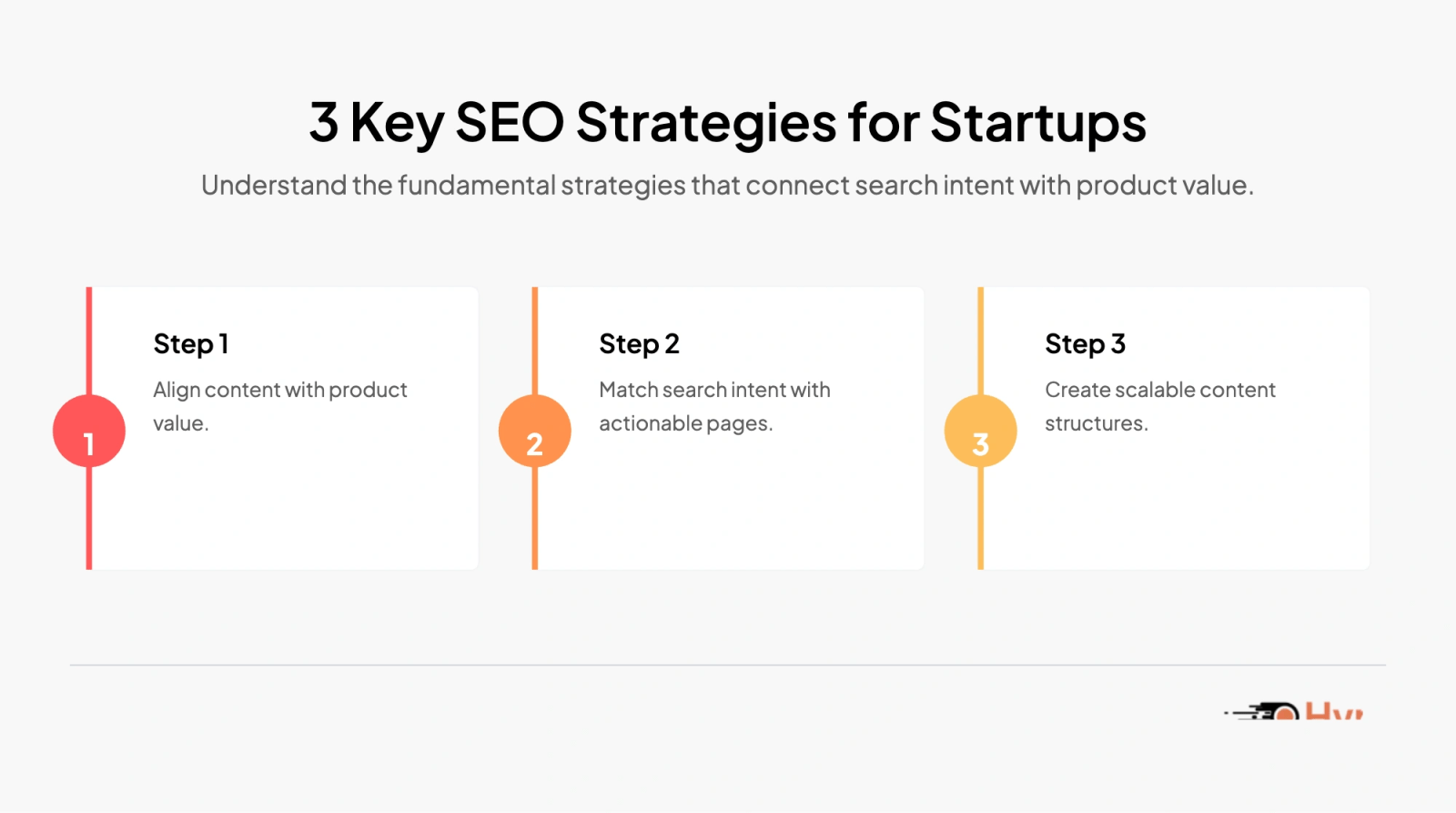
But underneath, the pattern is the same.
The best startup SEO strategies are deeply connected to the product.
Ahrefs writes about SEO because it sells SEO software. Zapier ranks for integrations because it connects apps. Wise ranks for currency conversion because it moves money. Typeform ranks for forms because it helps people create forms.
This is the first rule of SEO for startups:
Do not chase traffic. Chase relevant demand.
The highest-performing SEO pages are often pages where the next action is obvious.
If someone lands on:
How crucial is SEO for startup growth?
That is why SEO can become customer acquisition.
The page does not just answer a question.
It moves the user toward the product.
A lot of these companies did not win with one viral article.
They won with repeatable structures:
This is where many small teams fail.
They create content manually, one post at a time, with no repeatable structure.
Hyperblog is designed to help with this gap. It gives teams a more systematic blog publishing layer, where every post can ship with the right SEO structure, internal links, metadata, schema, content elements, and lead generation paths.
Good SEO is not only about keywords.
Google’s documentation continues to emphasize fundamentals like crawlability, indexability, links, structured data, page experience, and metadata. Google’s link guidance also explains that crawlable links and clear anchor text help discovery and understanding.
This matters because many startups publish good content but fail at the layer after writing:
That is why a blog platform matters.
The CMS should not just store content. It should help content perform.
Here is the practical playbook.
Startup type | Best SEO model |
SaaS tool with many integrations | Programmatic integration pages |
Do not copy a strategy just because another startup used it.
Copy the model that fits your product.
A strong startup SEO strategy needs more than top-of-funnel blogs.
You need:
For example, a SaaS startup should not only publish “what is X” articles.
It should also publish:
A lot of blogs fail because every post is isolated.
Internal links help users and search engines understand how your pages connect. Google’s link guidance specifically highlights crawlable links and descriptive anchor text as part of helping Google discover and understand pages.
For startups, internal links should connect:
Hyperblog can help by suggesting and managing internal links automatically, which is especially useful for lean teams that do not have a dedicated SEO manager reviewing every article.
Traffic without conversion is not enough.
A blog post should have contextual next steps:
This is one of the biggest gaps in startup content.
Many blogs rank but do not convert because the CTA is generic or buried at the bottom.
Hyperblog is built with lead generation in mind. It can support personalized lead magnets, section-based lead magnets, inline forms, popups, sticky forms, and CTA buttons so blog traffic has a real path to pipeline.
AI search does not make SEO irrelevant.
It makes structure more important.
Google’s AI features guidance still points back to core SEO fundamentals. And newer research around answer-engine optimization shows that AI referrals can grow, but teams need to measure carefully and avoid confusing platform growth with optimization impact.
For startups, AI-ready content should include:
This is exactly where Hyperblog’s AI-search-ready features fit naturally.
These startup SEO case studies show that SEO success has two parts.
The first part is strategy:
The second part is infrastructure:
Most startups can handle the first part if they understand their customers.
They struggle with the second part because it becomes manual, repetitive, and easy to forget.
That is why Hyperblog exists.
Hyperblog is built for teams that want blogs to be ready for:
The goal is simple:
You focus on writing and expertise. Hyperblog handles the technical and growth layer around every post.
SEO helped startups win customers because it met buyers where they were already searching.
The first step is to choose the right SEO model that aligns with your product and market.
Startups can create template pages that meet specific search intents, leading users directly to product activation.
Internal linking helps search engines understand page relationships and improves user navigation.
Technical SEO ensures that your site is crawlable, indexable, and optimized for search engines.
AI search requires structured content that is easily digestible by AI systems, maintaining core SEO principles.
Ahrefs taught people how to do SEO. Zapier ranked for integrations. Wise built useful currency tools. Webflow, Notion, Miro, ClickUp, Canva, and Typeform turned templates into acquisition assets. Plausible used opinion-led content to build trust and demand. Glasp shows how AI-answer visibility is becoming the next layer of search.
The lesson is not “publish more.”
The lesson is:
Build a content system that connects search intent to product value.
That is what the best startup SEO case studies have in common.
And that is the future Hyperblog is building for.
A blog should not just go live.
It should rank, get discovered, engage readers, and convert them into customers.
Subscribe to Our Newsletter
Stay up to date with our latest news and updates.
Join our readers
No spam. Unsubscribe anytime.
Product-led content SEO |
Built a content engine around SEO problems, keyword research, technical SEO, and content marketing |
Teach the market before selling to it |
Plausible Analytics | Opinion-led and product-led content | Used transparent blogging, privacy positioning, and Google Analytics alternative content to grow without paid ads | Strong positioning can turn content into customer acquisition |
Zapier | Programmatic SEO | Built app and integration pages at scale | Product inventory can become search inventory |
Wise | Programmatic SEO | Built currency conversion pages for thousands of currency-pair searches | Useful tools can rank and convert at the same time |
Webflow | Template SEO | Built searchable template pages that lead directly into product usage | Templates can reduce the distance from search to signup |
Nomad List | Data-led programmatic SEO | Built location pages for digital nomad queries | Unique data makes scaled pages useful |
G2 | Category and comparison SEO | Built software-category and comparison pages at scale | Buyer-intent pages can capture decision-stage traffic |
Notion | Template marketplace SEO | Built a large template marketplace with categories and community creators | User-generated templates can become a searchable growth loop |
ClickUp | Template SEO | Built 1,000+ templates across work categories | Templates can capture workflow-specific searches |
Miro | Template SEO | Built thousands of visual collaboration templates | Searchers often want a starting point, not just information |
Typeform | Template SEO | Built form and survey templates for many use cases | Bottom-funnel templates turn intent into product usage |
Canva | Template SEO | Built searchable design templates around high-volume visual creation jobs | Search demand can map directly to creation intent |
VEED | Tool-led SEO | Built pages around individual video editing jobs and tools | Free tools can become acquisition pages |
Jasper | Content hub SEO | Built a blog around AI marketing and content workflows | AI startups can educate markets that are still forming |
Copy.ai | Content hub SEO | Built practical AI workflow content for marketers and sales teams | Category education can create demand |
Glasp | AEO / AI-search optimization | A study on Glasp found AI-answer optimization produced a treatment-aligned lift in ChatGPT referral traffic | AI discovery is becoming part of SEO strategy |
Template SEO |
Tool that performs specific jobs | Free tool SEO |
Complex B2B product | Educational and comparison SEO |
New AI category | Category education and workflow SEO |
Data-heavy product | Data-led programmatic SEO |
Strong founder POV | Opinion-led content SEO |