
Nextjs Blog CMS
Best Blog CMS for Next.js sites in 2026: Compared by SEO, AI Visibility, Publishing Workflow, and Lead Capture
 Muthu
Muthu13 June 2026

SHARE:
MuthuChoosing the best blog CMS for a Next.js site is not just a technical decision.
It is a growth decision.
A simple CMS can help you publish posts. But a SaaS blog needs more than publishing. It needs technical SEO, fast page experience, structured content, AI-search readiness, lead capture, analytics, visual assets, internal linking, and a workflow that does not turn every blog update into an engineering ticket.
That is why the best CMS for a Next.js blog depends on what you are trying to build.
If you need a flexible structured-content backend, tools like Sanity, Contentful, Hygraph, Storyblok, Payload, Strapi, and Prismic are strong options.
If you need a publishing and newsletter platform, Ghost is strong. If you already have a WordPress editorial team, headless WordPress can work.
But if your goal is specifically to run a SaaS marketing blog on a Next.js site that ranks, gets understood by AI search systems, captures leads, and stays out of the engineering backlog, you need to evaluate CMS platforms differently.
Which feature do you prioritize the most?
This guide compares 12 options using a practical SaaS blog scoring model.
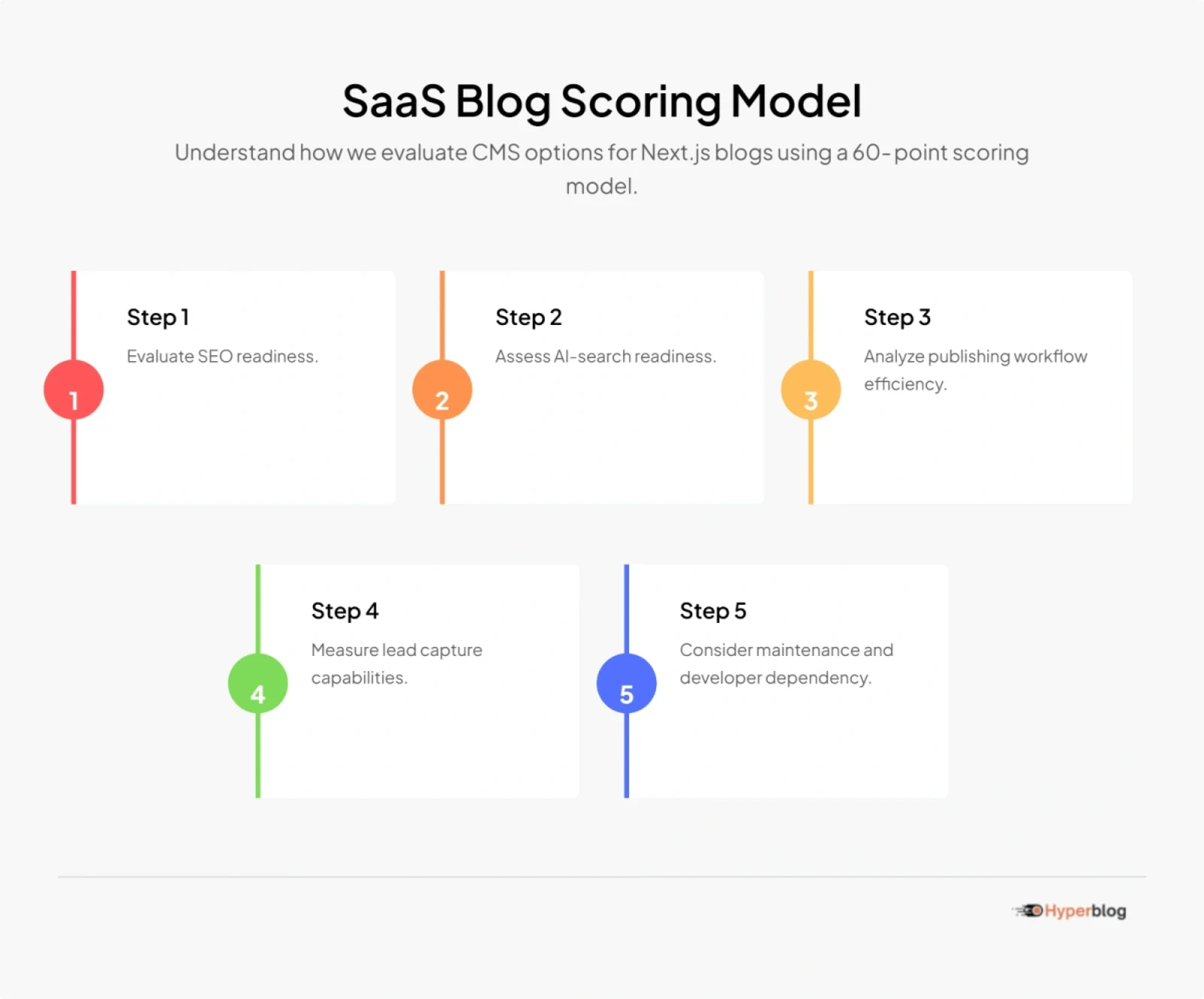
We compared 12 CMS options for Next.js blogs across 6 criteria:
Our recommendation:
Use case | Best option |
Best overall for SaaS marketing blogs on Next.js | Hyperblog |
Our POV:
The best blog CMS for a Next.js SaaS site is not the one with the most flexible content model. It is the one that helps your content team publish, rank, get cited, convert readers, and move without waiting on developers.
This score is based on a SaaS blog growth use case, not general CMS quality.
A platform can score lower here and still be excellent for enterprise websites, documentation, apps, ecommerce, or complex content modeling.
Rank | CMS | Total score / 60 | Best for | Main limitation |
We used a 60-point scoring model.
Criteria | Max score | What we evaluated |
Next.js fit | 10 |
This is not a lab benchmark. We did not run Lighthouse tests or measure each platform on the same production site.
This is a public-docs and product-positioning comparison for one specific question:
Which CMS is best for running a growth-focused SaaS blog on a Next.js website?
Google’s AI Search guidance is clear: SEO is still relevant for generative AI Search because Google’s AI features rely on core Search ranking and quality systems. Google also says AI Search can use retrieval-augmented generation and query fan-out to retrieve relevant, up-to-date pages from its index. (Google for Developers)
That means AI visibility is not about adding fake “GEO hacks.”
It is about building content that is:
Google specifically says unique, compelling, useful content is likely to matter more for generative AI visibility than most other tactics, and it also warns against creating pages just to capture every fan-out query variation. (Google for Developers)
So the best CMS for a Next.js blog should help your team create better information faster.
Not just publish words.
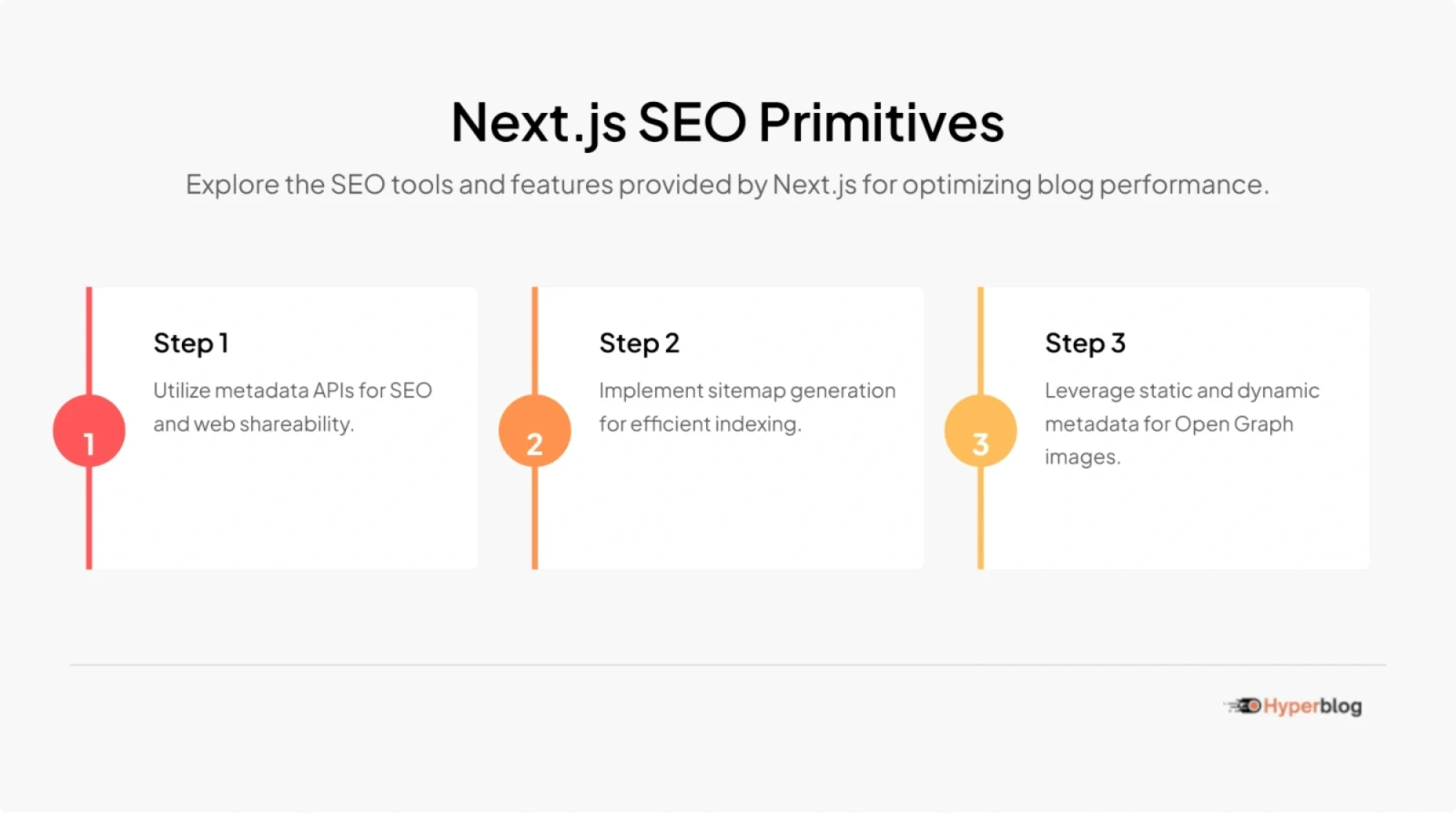
Next.js gives developers strong primitives for SEO.
For example, Next.js supports metadata APIs for SEO and web shareability, including static metadata, dynamic generateMetadata, and file conventions for Open Graph images. It can also automatically generate relevant <head> tags. (Next.js)
Next.js also supports sitemap generation through sitemap.xml, sitemap.js, or sitemap.ts, which helps search engines index the site more efficiently. (Next.js) It also supports static or generated robots.txt files to tell crawlers which URLs they can access. (Next.js)
But here is the key point:
Next.js gives you the tools. It does not automatically give your marketing team a blog growth system.
Someone still has to build, connect, maintain, and QA:
That is why the CMS choice matters.
Which feature do you prioritize the most?
Best for SaaS marketing teams that want SEO, AI visibility, lead capture, and publishing speed without dev dependency.

Hyperblog is the strongest fit for this specific use case because it is not just a CMS. It is built around the full blog growth workflow: ranking, loading fast, engagement, and lead conversion.
Hyperblog’s homepage positions it as “The Blog CMS Built to Rank Higher and Convert Faster,” with built-in features across SEO, AI / LLM search, engagement, and lead generation. (Hyperblog) Its documentation also says Hyperblog goes beyond publishing by helping generate visuals, infographics, polls, and lead magnets based on reader behavior and intent.
Score
Criteria | Score |
Next.js fit | 8 |
SEO readiness |
Why Hyperblog scores high
Hyperblog’s biggest advantage is that it solves the parts most headless CMSs leave to the team:
Its Auto Technical SEO page says Hyperblog handles backend SEO for every blog post, including meta tags, schema markup, FAQ structured data, Core Web Vitals, canonical URLs, sitemaps, and AI search visibility. (Hyperblog) Its lead magnet feature is also built directly into the blog workflow: Hyperblog says it can automatically design, place, and deliver personalized blog lead magnets based on the post topic.
Best for
Not best for
Verdict
Hyperblog is the best choice if your main goal is:
“We have a Next.js site, and we want our content team to run a growth-focused blog without asking developers for every SEO, visual, CTA, or lead capture update.”

ButterCMS is one of the most direct alternatives if the goal is specifically to add a blog to a Next.js site.
ButterCMS describes itself as an API-based NextJS blog engine that integrates with new and existing NextJS apps. It highlights a friendly admin interface, simple content API, SEO control, tags, categories, author profiles, RSS/Atom feeds, search, and webhooks. (ButterCMS) Its documentation says the Blog Engine includes posts, authors, categories, tags, and SEO fields out of the box.
Score
Criteria | Score |
Next.js fit | 9 |
SEO readiness |
Best for
Not best for
Verdict
ButterCMS is strong if you want a traditional blog engine that can be added quickly to a Next.js app. Hyperblog is stronger if the priority is not just publishing, but also AI visibility, lead capture, visuals, and conversion.
Best for publishing, newsletters, memberships, and audience growth.

Ghost is a strong publishing platform, especially when the business model includes newsletters, memberships, subscriptions, and audience ownership.
Ghost supports publishing by web and email newsletter, rich media, dynamic cards, built-in newsletters, audience signup forms, memberships, subscriptions, and native analytics. (Ghost) Ghost also has developer documentation for using Ghost as a headless CMS with Next.js.
Score
Criteria | Score |
Next.js fit | 7 |
SEO readiness |
Best for
Not best for
Verdict
Ghost is excellent for publishing and audience building. For a SaaS marketing blog, it may need more work to match product-specific lead capture, content attribution, and AI-search positioning.
Best for flexible structured content and custom content operations.

Sanity is one of the strongest headless CMS options for Next.js teams that need flexible content modeling.
Sanity positions itself as a headless CMS and content operating system for Next.js, with flexible content modeling, real-time APIs, and built-in AI automation. (Sanity.io) Sanity also has next-sanity, an official integration package designed for Next.js patterns such as Server Components, App Router data cache, and Draft Mode.
Score
Criteria | Score |
Next.js fit | 10 |
SEO readiness |
Best for
Not best for
Verdict
Sanity is excellent when content structure is the main problem. But if the problem is specifically “we need a SaaS blog that ranks and converts without engineering dependency,” it will require additional implementation around SEO, lead capture, and analytics.
Best for visual editing and marketing-site content.

Storyblok is strong when marketers need visual editing while developers keep control over the frontend.
Storyblok’s Next.js documentation covers integrating Storyblok with a Next.js App Router project. (Storyblok) Its Visual Editor documentation says Storyblok combines WYSIWYG editing with freedom to customize both backend and frontend, and it supports real-time content editing and preview interactions.
Score
Criteria | Score |
Next.js fit | 9 |
SEO readiness |
Best for
Not best for
Verdict
Storyblok is a strong CMS for visual marketing sites. For a dedicated SaaS blog growth system, you will still need to build the SEO, AI-search, and lead capture layer around it.
Best for enterprise composable content platforms.

Contentful is a strong option for larger teams that need a composable content platform and scalable content operations.
Contentful offers a Next.js starter and says the combination of Next.js and Contentful can help build scalable dynamic static websites with improved SEO and performance. (Contentful)
Score
Criteria | Score |
Next.js fit | 9 |
SEO readiness |
Best for
Not best for
Verdict
Contentful is powerful, but it may be more CMS than a SaaS blog team needs. It is a better fit when content operations are broad and enterprise-grade, not when the core job is “launch a blog that ranks and converts.”
Best for slice-based websites and landing pages.

Prismic is useful for teams that want structured page sections and reusable slices for marketing websites.
Prismic’s Next.js documentation says it has a first-party Next.js integration that supports content modeling, generated TypeScript types, draft previews, live previews, and full-website previews. (Prismic)
Score
Criteria | Score |
Next.js fit | 8 |
SEO readiness |
Best for
Not best for
Verdict
Prismic is a good CMS for websites and landing pages. For a dedicated SaaS blog, it may need additional work around content hubs, blog SEO, lead capture, and AI-search readiness.
Best for developer-owned, self-hosted, TypeScript-first CMS infrastructure.

Payload is powerful if your team wants to own the backend and keep the CMS close to the Next.js stack.
Payload describes itself as an open-source headless CMS and application framework built with TypeScript and React. It positions itself as a Next.js backend used in production and emphasizes a code-first developer experience with content workflows for marketers. (Payload)
Score
Criteria | Score |
Next.js fit | 10 |
SEO readiness |
Best for
Not best for
Verdict
Payload is excellent when engineering wants control. It is less ideal when marketing wants a turnkey blog growth system.
Best for GraphQL-first structured content and content federation.

Hygraph is strong when content needs to be modeled, queried, and federated across systems.
Hygraph’s Next.js documentation explains how to fetch and render content from Hygraph using Next.js dynamic routing, and points users to more complete starter implementations. (Hygraph)
Score
Criteria | Score |
Next.js fit | 8 |
SEO readiness |
Best for
Not best for
Verdict
Hygraph is strong for structured and federated content. For a SaaS blog, it still needs additional work to become a conversion-ready blog system.
Best for teams that already know and use WordPress.

WordPress is still familiar to many editorial teams. As a headless CMS, it can serve content through APIs and power a Next.js frontend.
The official WordPress REST API provides JSON access to WordPress content and can be used by external applications to interact with posts, pages, taxonomies, and other data. (WordPress Developer Resources) WPGraphQL also separates WordPress from the presentation layer and supports JavaScript applications, including Next.js. Vercel has a headless WordPress starter for Next.js that fetches posts, categories, tags, pages, and featured media. (Vercel)
Score
Criteria | Score |
Next.js fit | 7 |
SEO readiness |
Best for
Not best for
Verdict
Headless WordPress can work well, especially if your team already lives in WordPress. But for a Next.js SaaS blog, it can introduce operational complexity: hosting, plugins, API setup, revalidation, metadata syncing, redirects, and security.
Best for open-source API-first CMS projects.

Strapi is a popular open-source CMS option when teams want self-hosting and API control.
Strapi’s Next.js integration guide shows how to consume Strapi API content from a Next.js application. (docs-v4.strapi.io)
Score
Criteria | Score |
Next.js fit | 8 |
SEO readiness |
Best for
Not best for
Verdict
Strapi is a solid developer CMS, but it is not a dedicated SaaS blog growth platform. It works best when engineering is ready to own implementation and maintenance.
Best for developer-owned blogs, documentation, and static content workflows.

Contentlayer is not a traditional CMS. It is more of a developer content layer that lets teams import content as data directly into a JavaScript or TypeScript app. (Contentlayer)
Score
Criteria | Score |
Next.js fit | 9 |
SEO readiness |
Best for
Not best for
Verdict
Contentlayer / MDX can be excellent for developer-owned content. But if the marketing team needs to publish, optimize, refresh, and convert without developer help, it is usually the wrong fit.
Best CMS by use case
Use case | Recommended CMS |
SaaS blog that needs SEO + AI visibility + leads | Hyperblog |
Before choosing a CMS, ask these questions.
A CMS should not require engineering support for every article, metadata update, author change, CTA, or category.
If your team publishes frequently, this matters more than almost anything else.
For a Next.js blog, you need:
Next.js supports many SEO primitives, but the CMS and workflow determine whether they are consistently applied. (Next.js)
AI-search readiness does not mean a CMS can guarantee citations.
It means the CMS helps you create content that is:
Google says generative AI Search still depends on SEO fundamentals and high-quality, non-commodity content. (Google for Developers)
A SaaS blog should not only get traffic.
It should turn traffic into:
Most headless CMSs help you manage content. They do not automatically create the conversion layer.
That is a key difference between a general CMS and a blog growth CMS.
The hidden cost is not the first integration.
The hidden cost is everything after launch:
The best CMS is the one that reduces recurring work for your team.
Choose Hyperblog if your priority is blog growth
Choose Hyperblog if you want your Next.js blog to be a business channel, not just a publishing surface.
It is the best fit when your team cares about:
Choose Sanity, Contentful, Hygraph, Storyblok, Payload, Strapi, or Prismic if your priority is structured content
These platforms are stronger when you need:
They can absolutely power a blog. But you may need to build more of the blog growth layer yourself.
Choose Ghost if your priority is audience publishing
Ghost is a strong option if your content strategy is built around:
Choose WordPress if your team already depends on WordPress
Headless WordPress is a reasonable option if your editorial team already knows WordPress and your company is comfortable maintaining the WordPress backend, plugins, APIs, and Next.js frontend.
The best blog CMS for a Next.js site depends on the job.
If the job is:
“Manage structured content across a complex website.”
Choose a headless CMS.
If the job is:
“Run a newsletter or membership publication.”
Choose Ghost.
If the job is:
“Let developers own MDX content in Git.”
Choose Contentlayer or MDX.
But if the job is:
“Run a SaaS blog on a Next.js website that ranks, gets understood by AI search, captures leads, and does not depend on developers for every update.”
Then the strongest choice is a dedicated Next.js blog CMS built for SEO, AI visibility, publishing workflow, and conversion.
That is where Hyperblog fits best.
1. What is the best blog CMS for Next.js?
The best blog CMS for Next.js depends on your use case. For SaaS marketing blogs that need SEO, AI visibility, lead capture, and low developer dependency, Hyperblog is the strongest fit. For structured content, Sanity, Contentful, Storyblok, Hygraph, Payload, Strapi, and Prismic are strong options. For newsletters and memberships, Ghost is a strong choice.
2. Can I build a blog directly in Next.js without a CMS?
Yes. You can build a blog directly in Next.js using MDX, Markdown, Contentlayer, or a custom content system. This works well for developer-owned blogs. But for SaaS marketing teams, it can create bottlenecks because metadata, schema, lead capture, visuals, CTAs, analytics, and content updates often require developer support.
3. Is a headless CMS good for a Next.js blog?
Yes, a headless CMS can be good for a Next.js blog, especially if you need flexible content modeling or multi-channel content. But many headless CMSs are general content platforms. You may still need to build the blog-specific growth layer: technical SEO, internal linking, lead magnets, CTAs, analytics, and AI-search-friendly formatting.
4. Does the CMS affect AI search visibility?
Indirectly, yes. A CMS does not guarantee AI citations. But it can help or hurt AI-search visibility by affecting crawlability, structure, metadata, freshness, summaries, schema, internal linking, and how easily content can be understood. Google says generative AI Search still relies on core SEO systems, crawlable content, and useful non-commodity content. (Google for Developers)
5. Should SaaS teams use WordPress with Next.js?
Headless WordPress can work well if your team already uses WordPress and has the resources to maintain the backend, APIs, plugins, hosting, and Next.js frontend. But if your goal is a lightweight blog growth workflow with fewer plugins and less engineering dependency, a dedicated blog CMS may be a better fit.
6. What should a Next.js blog CMS include?
A good Next.js blog CMS should include SEO metadata, canonical URLs, schema, sitemap support, Open Graph images, author pages, category pages, publishing workflows, previews, internal linking, lead capture, analytics, and AI-search-friendly content structure.
Subscribe to Our Newsletter
Stay up to date with our latest news and updates.
Join our readers
No spam. Unsubscribe anytime.
Sanity |
Best for enterprise composable content | Contentful |
Best for visual editing and marketing pages | Storyblok |
Best for GraphQL content federation | Hygraph |
Best self-hosted TypeScript CMS | Payload |
Best open-source API CMS | Strapi |
Best for newsletter and membership publishing | Ghost |
Best for existing WordPress editorial teams | Headless WordPress |
Best simple blog engine for Next.js | ButterCMS |
Best slice-based website CMS | Prismic |
Best for developer-owned MDX blogs | Contentlayer / MDX |
1 | Hyperblog | 54 | SaaS blogs that need SEO, AI visibility, lead capture, and low dev dependency | Less suitable for highly custom enterprise content models |
2 | ButterCMS | 48 | Simple blog engine for Next.js apps | Less differentiated for AI visibility and advanced conversion workflows |
3 | Ghost | 46 | Publishing, newsletters, memberships | Headless Next.js setup still requires integration work |
4 | Sanity | 45 | Flexible structured content | Requires more setup for blog-specific SEO and lead capture |
5 | Storyblok | 44 | Visual editing and marketing sites | Blog conversion layer usually needs custom work |
6 | Contentful | 43 | Enterprise content operations | Can be heavy for a simple SaaS blog |
7 | Prismic | 41 | Slice-based websites and landing pages | Less blog-growth-specific out of the box |
8 | Payload | 40 | Developer-owned, self-hosted CMS | Strong dev control, but more engineering ownership |
9 | Hygraph | 39 | GraphQL-first structured content | Blog workflows and lead capture require custom implementation |
10 | Headless WordPress | 38 | Teams already using WordPress | Plugin, hosting, API, and maintenance complexity |
11 | Strapi | 35 | Open-source API CMS | Requires more dev work for SEO, workflow, and conversion |
12 | Contentlayer / MDX | 30 | Developer blogs and docs | Not ideal for marketing teams that need CMS workflows |
Integration quality, App Router compatibility, developer experience, routing flexibility |
SEO readiness | 10 | Metadata, canonical handling, sitemaps, schema, OG images, URL control |
AI-search readiness | 10 | Structured content, summaries, clean HTML, entity clarity, freshness workflow, citation-friendly content |
Publishing workflow | 10 | Editor experience, previews, authoring, drafts, approvals, non-dev publishing |
Lead capture | 10 | CTAs, forms, lead magnets, newsletter capture, CRM/email workflow |
Maintenance / dev dependency | 10 | How much engineering work is required after launch |
10 |
AI-search readiness | 9 |
Publishing workflow | 9 |
Lead capture | 10 |
Low dev dependency | 8 |
Total | 54 / 60 |
8 |
AI-search readiness | 7 |
Publishing workflow | 8 |
Lead capture | 7 |
Low dev dependency | 9 |
Total | 48 / 60 |
8 |
AI-search readiness | 7 |
Publishing workflow | 10 |
Lead capture | 8 |
Low dev dependency | 6 |
Total | 46 / 60 |
7 |
AI-search readiness | 8 |
Publishing workflow | 8 |
Lead capture | 4 |
Low dev dependency | 8 |
Total | 45 / 60 |
7 |
AI-search readiness | 7 |
Publishing workflow | 9 |
Lead capture | 5 |
Low dev dependency | 7 |
Total | 44 / 60 |
7 |
AI-search readiness | 7 |
Publishing workflow | 8 |
Lead capture | 4 |
Low dev dependency | 8 |
Total | 43 / 60 |
7 |
AI-search readiness | 7 |
Publishing workflow | 8 |
Lead capture | 4 |
Low dev dependency | 7 |
Total | 41 / 60 |
6 |
AI-search readiness | 6 |
Publishing workflow | 7 |
Lead capture | 3 |
Low dev dependency | 8 |
Total | 40 / 60 |
7 |
AI-search readiness | 7 |
Publishing workflow | 7 |
Lead capture | 3 |
Low dev dependency | 7 |
Total | 39 / 60 |
8 |
AI-search readiness | 6 |
Publishing workflow | 9 |
Lead capture | 5 |
Low dev dependency | 3 |
Total | 38 / 60 |
6 |
AI-search readiness | 6 |
Publishing workflow | 6 |
Lead capture | 3 |
Low dev dependency | 6 |
Total | 35 / 60 |
6 |
AI-search readiness | 5 |
Publishing workflow | 3 |
Lead capture | 2 |
Low dev dependency | 5 |
Total | 30 / 60 |
ButterCMS |
Newsletter and membership publishing | Ghost |
Flexible structured content | Sanity |
Enterprise composable content | Contentful |
Visual editing for marketing pages | Storyblok |
GraphQL-first content platform | Hygraph |
Self-hosted TypeScript CMS | Payload |
Existing WordPress editorial team | Headless WordPress |
Open-source API CMS | Strapi |
Slice-based marketing site | Prismic |
Developer-owned MDX blog | Contentlayer / MDX |